Am I Polysaturated or Just Busy? Distinguishing Polysaturation from Overextension and Sustainable Fullness

As you explore the concept of polysaturation, you might find yourself wondering: What if I’m not actually at capacity? What if I’m just busy?
It’s a fair question — and an important one.
In polyamory, polysaturation names the point at which your existing relationships already fill what you can sustainably hold. Adding another partnership would stretch your relational bandwidth past what allows you to stay present, responsive, and connected.
When you practice polyamory, your time, emotional energy, and logistical resources carry weight. There’s only so much of you to go around.
But not every busy season equates to polysaturation. A full life doesn’t automatically mean you’ve reached your relational limit. Many people practicing ethical non-monogamy or building richly connected communities express some version of, “I’m busy, but I’m good.” And sometimes that’s absolutely true.
At the same time, a full life naturally shapes how much bandwidth remains for additional commitments. What looks like healthy busyness on the surface can, at times, reflect chronic overextension that slowly wears down your energy, focus, and availability for the people and projects you care about.
So how can you tell the difference?
How do you know whether you’re:
simply moving through a manageable busy season that wouldn’t meaningfully limit additional relational commitments
stretched too thin by commitments outside of your partnerships
or genuinely polysaturated
In this post, we’ll explore these three related but distinct experiences so you can make sustainable choices about your time, energy, and relationships.
Sustainable Fullness: Living a Full Life Without Running Empty
Busy seasons are a natural part of a layered, multidimensional life. Commitments naturally accumulate when you invest in work, creativity, community, and care. Sometimes these responsibilities stack on top of each other, creating a familiar sense of busyness.
But a full schedule doesn’t automatically signal a problem. The key is whether your system can hold these demands without chronic depletion. Sustainable fullness describes a life that feels full while staying within your long-term capacity.
Defining qualities of sustainable fullness include:
Effort followed by recovery
Flexibility when unexpected events arise
Slack in the system to absorb new demands or disruptions
Remember the bucket analogy? The bucket represents your overall capacity—the total demand you can sustainably carry over time. The legos inside the bucket represent bandwidth: resources such as time, energy, emotional presence, and attention.
When you live in sustainable fullness, legos are drawn and replenished as part of your daily routine. Some days require more bandwidth than others, but recovery is built into the system. Certain activities can even refill legos in the bucket, as long as you leave space for restoration. For example, exercising temporarily consumes energy. But as your body integrates the physical gains, your increased stamina gradually expands your capacity, allowing you to take on more energy-demanding tasks.
In relational contexts, sustainable fullness means partnerships take effort but don’t create ongoing strain. You remain able to respond, repair, and adjust. If an unexpected challenge demands more attention—such as a scheduling conflict, a difficult conversation, or an unexpected illness—there’s enough elasticity in the system to absorb it.
You could be at or below your polysaturation threshold while in sustainable fullness, but you aren’t oversaturated. You might be busy, but you’re not chronically overextended. Sustainable fullness is a protective and generative state: it helps prevent burnout, maintain mental wellness, and preserve the capacity to grow. This state can be intentionally cultivated, helping you sustain a full, balanced, and connected life.
Sustainable Fullness in Practice
Daniel has two long-term partners, a demanding job, and a strong commitment to local politics. Every election season, he volunteers with a grassroots organization, spending evenings and weekends knocking on doors and canvassing for get-out-the-vote efforts.
October and November are predictably intense. His calendar fills up quickly, and his days run long. But none of this comes as a surprise—to Daniel or to his partners. He talks openly with them ahead of time about what the season will look like, naming that his availability will be more limited and that his energy will be stretched in specific, temporary ways.
To support this busier season, Daniel plans intentionally. He scales back on optional commitments, postpones non-urgent projects, and leaves clear space on his calendar for after the election. He knows he’ll need time to decompress, reconnect with his partners, and tend to the everyday life tasks that pile up when things get hectic.
The work itself matters to him. Canvassing aligns with his values, and advocating for candidates he believes in feels meaningful. When a voter tells him that their conversation helped them decide to cast a ballot, Daniel feels energized rather than drained. The effort costs him time and physical energy, but it also gives something back.
Although he feels tired some days, his relationships don’t suffer under the weight of this season. Relational labor with his partners isn’t what’s pulling on his capacity, and he’s still able to show up with care, presence, and follow-through. When something unexpected comes up, there’s enough slack in the system to adjust.
While Daniel’s life feels full during election season, his capacity remains intact, his relationships stay sustainable, and rest is already planned into what comes next.
This is sustainable fullness: a full life held with intention, support, and room to breathe—rather than a state of being stretched so thin from relational commitments that self-care becomes collateral damage.
When Busyness Becomes a Problem: Non-Relational Chronic Overextension
Most of us know what it feels like to be busy. Appointments line up like dominoes, leaving little white space on the calendar. You’re eating with one hand and typing with the other. Notifications buzz mid-conversation. You respond to messages while walking to the next obligation, already thinking about what comes after that.
It often feels manageable — until it doesn’t. You may not notice how long your nervous system has been running on high alert until one final stressor tips the balance and you find yourself unexpectedly in tears in the grocery aisle, craving quiet and stillness.
Busyness exists on a spectrum. Some seasons are full yet sustainable. Difficulty arises when your system doesn’t receive the space it needs to recover. Using the bucket analogy again: if you keep removing legos (bandwidth) without putting any back, eventually you’re reaching into an empty container.
Non-relational chronic overextension describes a pattern in which demands outside of romantic or intimate relationships consistently drain bandwidth faster than it replenishes. Work pressures, caregiving roles, financial stress, activism, health concerns, or systemic strain pull from available resources day after day, with little restoration built in.
Here, relational labor itself hasn’t pushed you beyond capacity. Instead, external demands consume so much bandwidth that little remains. Relationships may still be intact and even nourishing in theory. In practice, however, they get squeezed into leftover space — into the margins between deadlines and responsibilities. There’s minimal slack in the system.
As overall bandwidth shrinks, your relational threshold naturally lowers. Even if you are not polysaturated, adding new partnerships or increasing relational commitments in this state would likely move you in that direction. Left unaddressed, overextension often precedes burnout, as prolonged depletion eventually catches up with you.
Non-Relational Overextension in Practice
Caroline has one long-term partner she’s been with for four years. Their relationship is steady, affectionate, and mutually supportive. On paper, nothing in her romantic life feels overwhelming.
But the rest of her life has been relentless.
Her father’s health has declined over the past year. Since he designated her as his power of attorney, she has stepped into the role of primary medical advocate. She spends hours each week coordinating appointments, managing insurance paperwork, and fielding calls from specialists. At the same time, her workplace recently downsized, leaving her responsible for tasks that used to be shared across two positions.
Her evenings used to include stopping by the gym on the way home, cooking something nourishing, sitting down for an unrushed meal with her partner, and calling a friend or reading her favorite author before bed.
Now they look different. She grabs fast food between errands. The gym has gradually disappeared from her routine. Conversations with her partner revolve around whatever crisis unfolded that day. By the time she collapses into bed, she scrolls mindlessly — her body exhausted while her mind continues cycling through logistics.
Her relationship remains one of the most supportive parts of her life. But external demands consume nearly all of her available bandwidth, and she struggles to find reliable ways to replenish herself. Without consistent recovery, her capacity steadily erodes. She feels thin, brittle, and easily overwhelmed.
Caroline recognizes what’s happening: she’s depleted. If space for restoration isn’t carved out, the strain will only continue to compound.
Polysaturation: Knowing Your Relational Threshold
Polysaturation is a capacity threshold specific to polyamory.
It marks the point at which relational labor already occupies your sustainable bandwidth, so adding another partner—or increasing commitments within existing relationships—would compromise your ability to stay present, responsive, and connected. Even if work and other areas of life feel manageable, the cumulative demands of multiple partnerships can fill your relational capacity.
Polysaturation doesn’t describe a set number of relationships. Rather, it reflects your subjective experience of reaching—or exceeding—your relational limit.
Common signs include:
Adding another relationship would compromise existing ones
Time, energy, or attention shortages require constant negotiation
Repair conversations accumulate because there’s no space to tend to them
Partnerships feel heavy instead of light-hearted and connective
You can reach your polysaturation threshold while still maintaining sustainable fullness. But consistently exceeding that threshold increases the risk of burnout and relational strain. Your relational capacity may also be reduced if non-partner responsibilities chronically consume your bandwidth.
Polysaturation in Practice
Tasha lives with her two long-term partners in a cozy, loving home. The three of them tag-team household management, share calendars and responsibilities, and send group texts about who’s picking up groceries. She cares about both relationships and takes pride in being emotionally present, communicative, and accountable.
Recently, she and one of her nesting partners decided to begin relationship counseling together. Tasha was genuinely excited. Strengthening communication and deepening connection matter to her. Each week they attend sessions and carve out intentional time for therapy homework. The work feels meaningful and worthwhile.
Around the same time, Tasha joined a dating app to casually explore new connections. At first, the flirting felt energizing. She enjoyed the playful exchanges, the anticipation of first dates, and the spark of possibility – whether that meant a one-time encounter or something with longer-term potential.
But slowly, something shifts.
She realizes she’s been less attentive to her other live-in partner. She’s a little distracted and less playful. Small bids for connection feel harder to meet, and she’s even started to get snippy here and there. Her partner gently mentions feeling somewhat sidelined.
She also notices dating app notifications piling up before she answers them. Messages that once felt exciting now feel like another task waiting to be managed. By the time she opens the app at the end of the day, she feels relationally tapped out.
When someone suggests meeting up, instead of eagerness she feels a wave of fatigue. I don’t have it in me to go on another date, she thinks, already rehearsing how to cancel gracefully.
One evening, while staring at a message she doesn’t have the energy to answer, something settles clearly in her body: she doesn’t actually want to date right now.
She’s full.
Her existing relationships are already occupying her sustainable relational bandwidth. There isn’t enough room to add new commitments without something else thinning out.
Tasha recognizes the feeling for what it is: she has reached her polysaturation threshold.
Comparing the Three Concepts
Although Sustainable Fullness, Non-Relational Overextension, and Polysaturation all describe how life’s demands interact with your energy and attention, each represents a distinct experience. Understanding the differences helps you recognize where strain is coming from and how to respond.
1. Sustainable Fullness
What it is: A life that feels full but manageable. Both relational and non-relational commitments fit within your capacity, with built-in recovery.
Source of strain: Can be relational or non-relational, but the system remains elastic.
Key sign: You feel stretched at times, but your body, mind, and relationships have space to recover. Unexpected changes can be accommodated without major disruption.
2. Non-Relational Overextension
What it is: A pattern in which demands outside of your romantic or intimate relationships consistently draw more bandwidth than can be replenished. Work, caregiving, health challenges, activism, or systemic pressures can steadily consume time, energy, and attention.
Source of strain: Primarily non-relational.
Key sign: Energy is consumed by external obligations. Life feels like a constant scramble, and rest rarely feels sufficient. Over time, this can both decrease your polysaturation threshold and lead toward burnout.
3. Polysaturation
What it is: A polyamory-specific threshold where relational labor itself occupies most or all of your available bandwidth. Adding partners—or increasing commitments within existing relationships—would compromise the quality of care, attention, or presence you can provide.
Source of strain: Primarily relational, though the amount of available relational bandwidth can be influenced by non-relational demands elsewhere in your life.
Key sign: Existing partnerships already require most of your relational capacity. Small disruptions or unmet needs quickly ripple across multiple relationships.
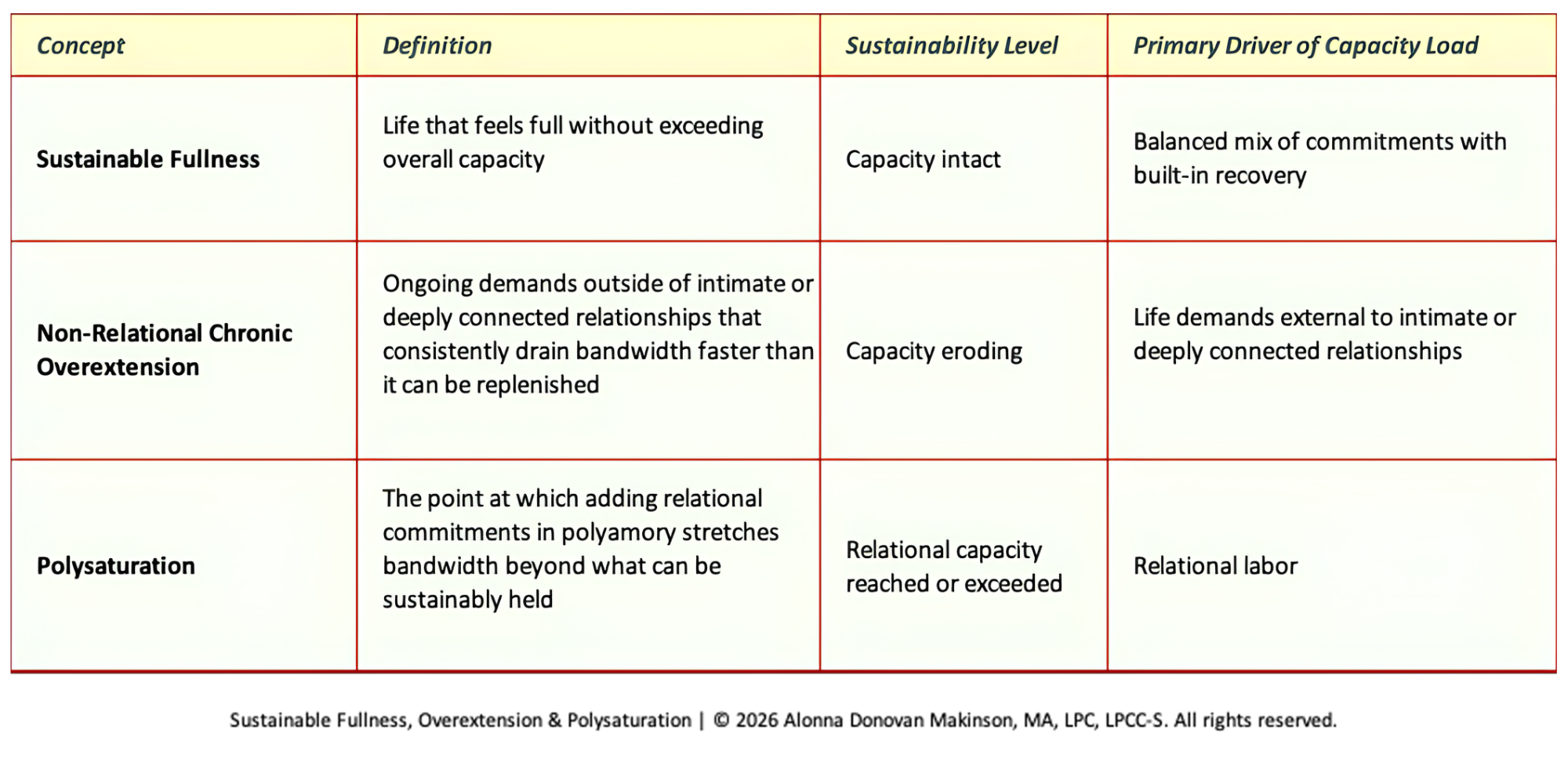
These three concepts interact in important ways. Polysaturation can occur with or without non-relational overextension, but when external demands are high, relational strain compounds overall stress. Conversely, non-relational overextension alone can reduce the number of relationships you could sustainably maintain by lowering your effective relational capacity. Sustainable fullness represents the ideal balance, where relational and non-relational demands coexist within capacity, with slack for recovery, unexpected events, and additional commitments. Keeping these distinctions in mind allows you to recognize where strain originates and take intentional steps to protect both your energy and your relationships.
So… Are You Polysaturated or Just Busy?
Busyness exists on a spectrum. You might be moving through a meaningful, temporary season your system can hold with care and intention—or carrying external demands that steadily erode your bandwidth, nudging you toward burnout. At times, circumstances outside your control stack on top of one another, and you find yourself straining under their weight—like Atlas holding the world on his shoulders.
These states don’t reflect your worth, your dedication to polyamory, or your ability to give and receive love. They simply describe how much your nervous system, time, and emotional resources can realistically carry right now.
When assessing whether you’ve reached your polysaturation threshold or are simply in a busy spell, you aren’t just noticing how relational commitments pull from your bandwidth—you’re also observing how energy flows across your entire life. Seeing how these concepts apply to you highlights patterns in your energy and commitments, giving you the insight needed to adjust priorities, build in recovery, scale back where necessary, or intentionally pause expansion.
Sustainability doesn’t require shrinking your life or abandoning what you value. It allows you to hold your life in ways that support presence, connection, and health. In doing so, you empower yourself to fully engage with the relationships and pursuits that feel most meaningful.
If you’d like help untangling whether you’re polysaturated or simply navigating a busy season, I offer therapy for clients in Virginia, Ohio and Kentucky. Schedule a free consultation call to explore your goals, get your questions answered, and see if working together feels like a good fit.